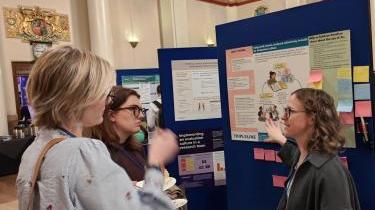
Triple Line recently attended the #UKES 2026, with the theme “Bridging the Gap: evaluation to action”. A running topic was how we as evaluators and learning partners can ensure our work is genuinely used to inform programming and policy rather than sitting on a shelf gathering dust. Check out our key takeaways below:
Lessons from Uganda: Owning Your Evaluation Ecosystem
One of the most inspiring sessions, “Building Uganda’s Evaluation Ecosystem: Capacity, Practice, and Impact”, came from a panel of civil servants and evaluators representing Uganda's growing evaluation infrastructure that has seen a significant push to institutionalise evaluation within government systems. They spoke of evaluators being stationed in most government departments and a strengthened professional development pipeline to support young Ugandan evaluators. This shift to a more integrated national evaluation ecosystem is contributing towards an embedded evaluative mindset amongst policymakers and ministries, an exciting trend that also highlights the shifting roles of evaluators to further the impact of evidence and strengthen decision-making.
The Report is Not the Product
Verian’s excellent session titled "We Read It, We Filed It, We Forgot It", shared findings from research conducted with evaluators and evaluation users . It highlighted the importance of encouraging evaluation commissioners to recognise that the evaluation report is not the final product; instead dissemination, communication, and active uptake and use of findings are where the real impacts are seen. This is easier said than done. Commissioning processes and contractual norms make the final report an obvious, tangible deliverable. Evaluation reports also play a crucial role in transparently documenting the methodology and analysis that provides the rationale for final findings and recommendations. But the conversation pushed us to think how we, and our clients, can invest more deliberately in what happens after the report lands and to consider what our role as evaluators actually is – helping our clients and their programmes to connect evidence, strategy and decisions for stronger implementation.
AI in Evaluation: Practical Tools, Honest Limits
AI came up in a big way. It was interesting to hear how different evaluators are (and are not!) choosing to integrate AI into their work. The "Human-in-the-Loop" roundtable on AI in evaluation was one of the most practically useful conference sessions, featuring evaluators from NIRAS, Oxford Policy Management, Itad, and Causal Map Ltd. The panel spoke on the challenges of integrating AI in a meaningful and responsible way, both in relation to quality and robustness of outputs and in terms of data security. The general consensus in the panel was the value of AI in doing the “boring jobs” so that evaluators can spend more time tackling specific problems that require nuanced judgement and skills in navigating complexity. However, there is a long way to go before it is obvious how we integrate AI into evaluation without it actually taking up more time and resource than an evaluation without it. This also speaks to the changing and expanding roles of evaluators, both as we learn to adapt AI into our work flows and also in providing capacity to lean into the communication and dissemination aspects of our role to ensure uptake of findings.
Presenting Our Bridges
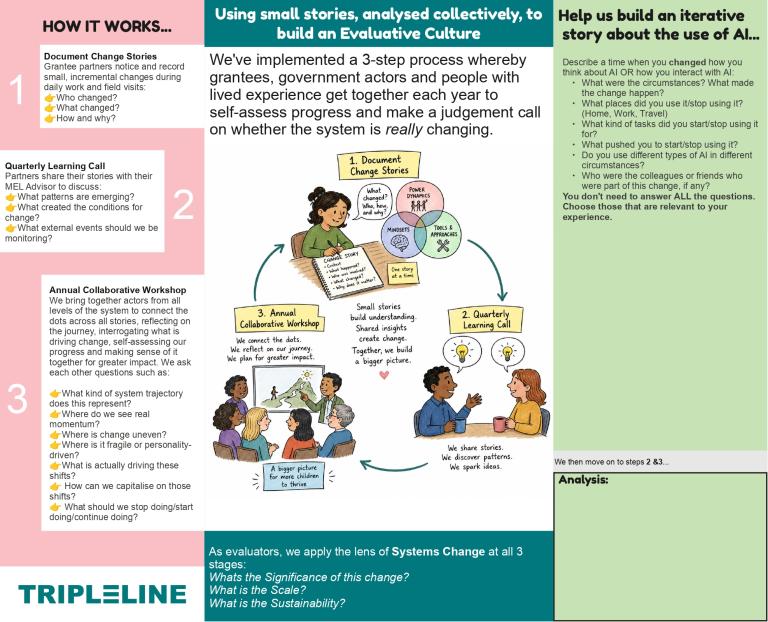
We were proud to present our own methods on “bridging the gap” between evaluation and action, also winning ‘Best Presented Poster Presentation’ at the conference.
In our role as Learning Partner for a philanthropic foundation, we collect and build on small incremental stories of change from grantee partners to support adaptive programme management. It was exciting to speak to fellow evaluators on how to embed evaluation and learning in implementing teams’ thinking and day-to-day work, and learning how others are applying tools such as Most Significant Change and Outcome Harvesting to achieve similar results. Our colleague Binh Tran also presented on how she uses Results Frameworks, Theory of Change and routine project management practices to support programme teams to better monitor uncertainty, adapt in real time, and build a shared ownership of evaluation as an ongoing practice rather than an end-of-project exercise – all in a whirlwind “pecha kucha” presentation.
Who Is an Evaluator?
If we start to consider the converging roles of evaluators and implementers, the question ‘who is an evaluator’ starts to emerge. Ipsos Mori presented their recent baseline survey, the State of Evaluation in the UK report, that considers who evaluators are as a community. When asked to define evaluation, survey respondents provided almost 300 different definitions – spanning learning and improvement, accountability, judgement, and methodological rigour. Evaluators as ‘interpreters’ was another suggested role, connecting the dots from data collection and analysis to playing a critical role in advocating and supporting the implementation of findings. This discussion of what evaluation is and is not, and what our roles are within it in the current climate, almost opened up more questions than it answered but it was positive to see that the wider evaluation community is not so different to our team at Triple Line – bringing together many different backgrounds and specialities, with a mixture of those who identify as social researchers and pure evaluators, to others who have specialised in programmatic work or become experts in thematic areas and found themselves in the evaluation space.
At a difficult time for the sector, it was an encouraging and inspiring few days coming together with fellow evaluators who work in the UK and globally, sharing ideas on how we can learn, do better and work together to protect the evaluation space and encourage donors and government alike to continue to invest in evidence-based decision making through our work. Taken together, these conversations at UKES 2026 point to a redefined role for the evaluator. We are no longer, if we ever really were, just evaluators. We are increasingly expected to act as translators that move between evidence and decision-making, between technical findings and strategic action, between what the data says and what a decision-maker can actually use.
That asks something different of us. It asks us to think beyond methodology and report writing into communication, timing, and influence. It asks us to draw on the full breadth of what evaluation means, a community spanning disciplines, sectors, and definitions while resisting the pressures that narrow who gets a seat at the table. And it asks us to engage thoughtfully with AI: not uncritically, but fluently, knowing where it genuinely extends our capacity and where human judgement is non-negotiable.
The gap between evaluation and action has always existed. What UKES 2026 made clear is that closing it is now firmly part of the job description. We’d love to hear from you if you'd like to discuss any of these themes in relation to your own evaluation work and how you’re seeing the evaluation sector shift.
UKES Poster: "From Evaluation to Embedded Learning: Building cultures of reflection and trust"
Credit: Esther Winslow, Triple Line